
What it actually costs to staff a care service: insights for CFOs from the HealthInvestor Summit 2026.
Ask a social care provider CFO what keeps them up at night and the answer is rarely one thing. Workforce spend is creeping up, margins are thinning, and there is no real-time visibility of either.
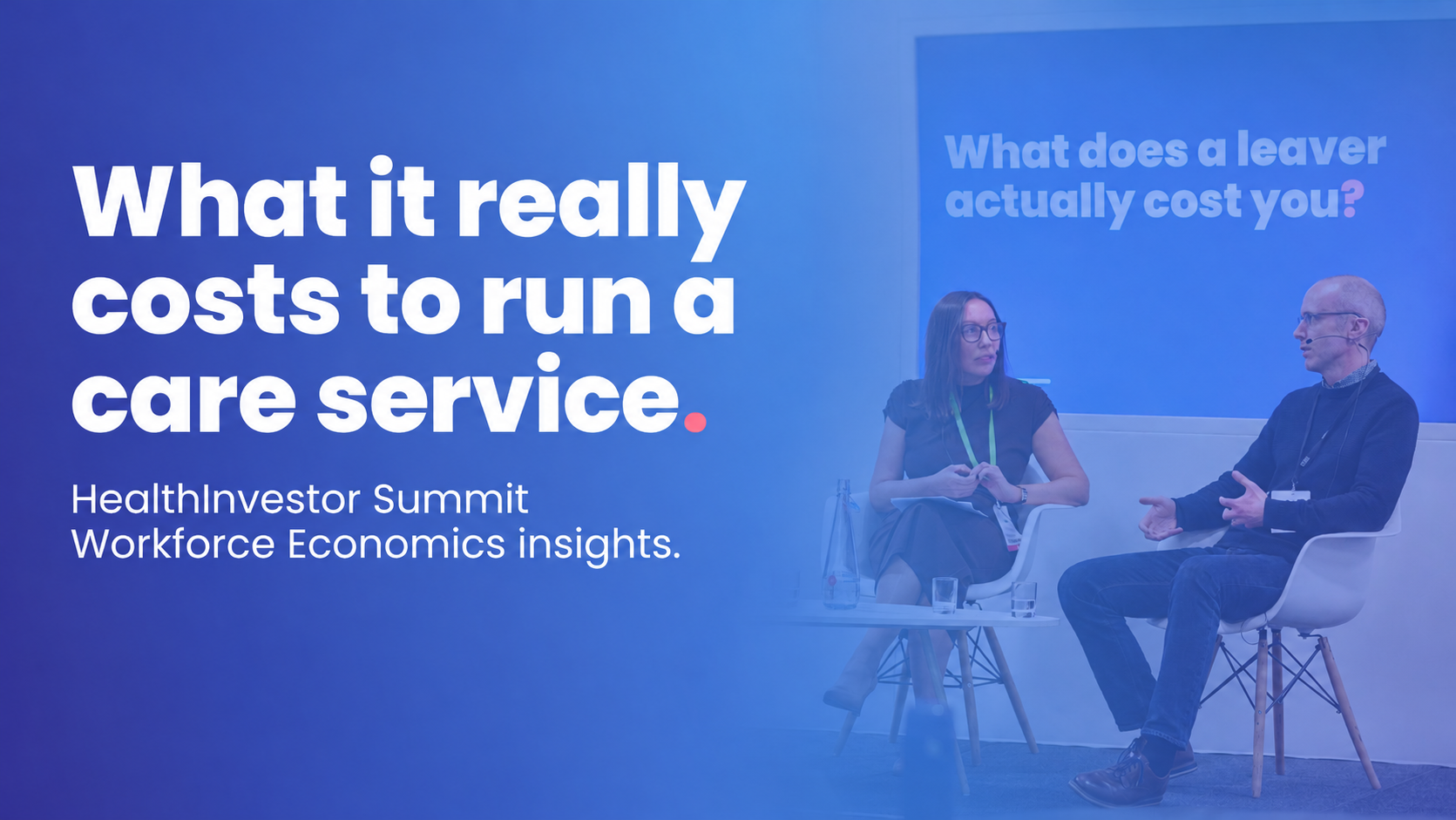
On 22 September, we sponsored the Workforce Economics and Productivity in Health and Social Care stream for CFOs at the Healthcare Summit in London, hosted by Nexus Media Group. It brought together finance leaders in care who are making big decisions about staffing across their services.
Why the numbers matter.
Adult social care in England employs about 1.59 million people across roughly 1.69 million posts. It is one of the largest workforces in the country, and almost everything a provider currently knows about it describes a year that has already finished. So the questions for finance leaders are these: do they have numbers they can trust, and can they accurately track workforce trends as they happen?
What almost nobody can see is the two halves put together. Take what the data says about the workforce you actually have, add what is already legislated to happen to it, and work out what that does to the cost of running a service. That is what it costs to staff a care service, and what is already scheduled to change it.
Fewer still can tell you what a single leaver costs, because it never appears as a line in a P&L. It is spread across recruitment, checks, induction, training, the productivity ramp while someone learns the service, and the cover you buy while the post sits empty.
The panel.
Our CEO, Ashley Haveloch-Jones, chaired the discussion alongside Neil Robinson, CFO at iVolve Care & Support, and Ilona Bartyzel, CFO at Fairlie Healthcare Group. Together they shared valuable insights into what it really costs to run a care service and how to plan for the changes ahead.
The key takeaways.
What’s certain. Staff turnover is already costing providers far more than their accounts show. Because the cost is spread across so many budget lines, most providers can’t put a pound figure on a single leaver.
What’s likely. The pay ladder is likely to keep flattening, and scrutiny of sponsored workers is likely to increase. The Fair Pay Agreement, as drafted, sets a floor at entry level and says nothing about the people above it, so the gap between experienced staff and new starters will keep closing unless providers protect it themselves.
What’s still unknown. The biggest open question is who pays for the ladder. If the Fair Pay Agreement funds the floor but not the rates above it, the cost of keeping experienced people progressing falls to providers, and nobody yet knows how that will be funded.
What it will actually cost by April 2029. Even on a cautious 3% Fair Pay Agreement uplift, our model shows it costing about £4,300 more per bed per year to staff a home than it does today. For a 40-bed home, that comes to about £172,000.
Want your numbers?
If you missed the session, you can run your own numbers in our Total Shift Cost Calculator and download a copy of our Workforce Economics 2026 report.
Prefer to talk it through? Book a chat and we’ll show you where your spend is hiding.