
The right to work rules now reach agency and substituted workers
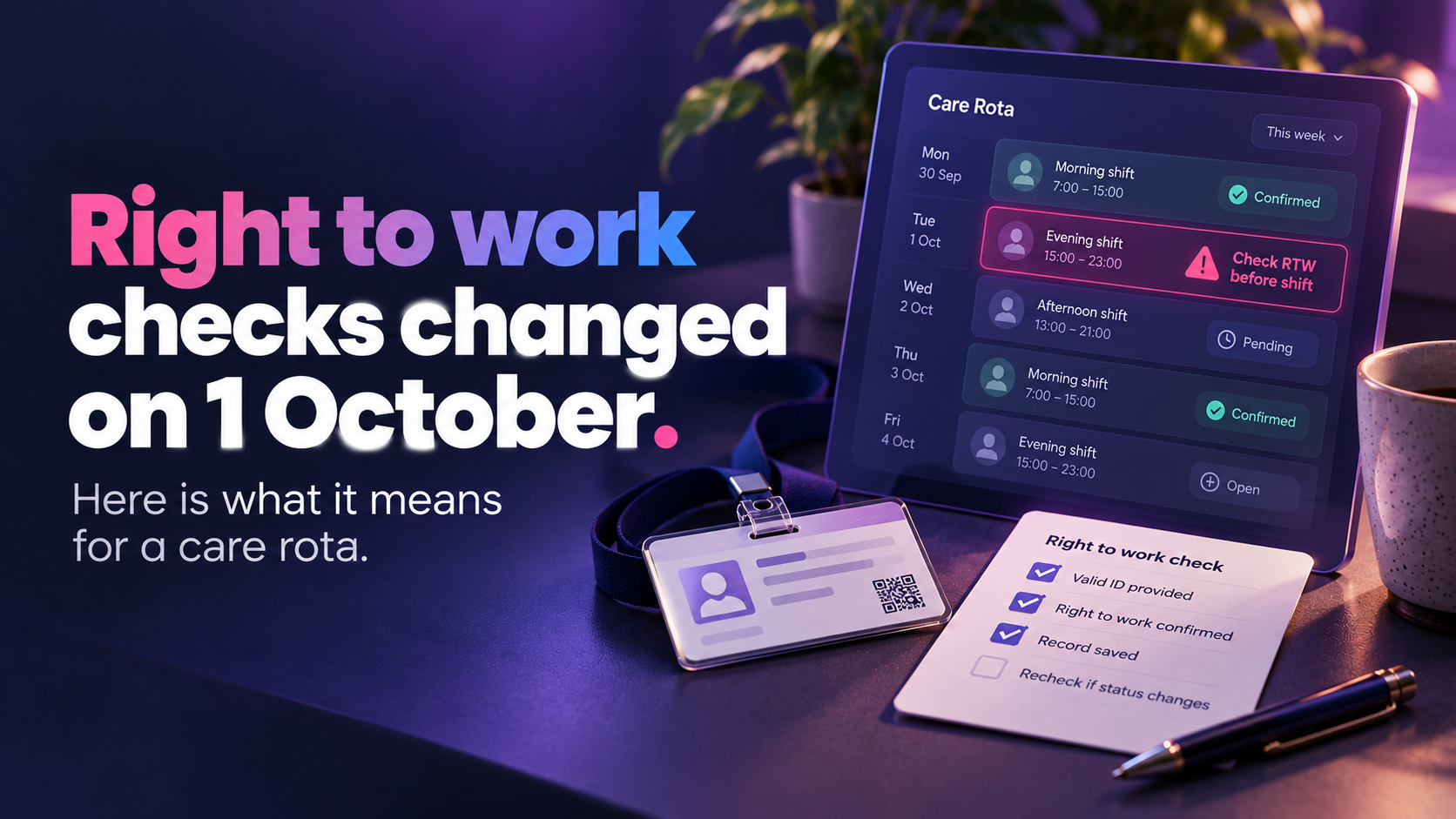
On 1 October 2026, section 48 of the Border Security, Asylum and Immigration Act 2025 came into force, along with a new statutory Code of Practice. It widens who employers have to carry out right to work checks on, and the civil penalty for getting it wrong reaches £60,000 per worker.
Most of the commentary has focused on construction and the gig economy. Very little of it has looked at what the change means for a service that fills shifts at short notice, which is most of social care.
What actually changed
Before 1 October, the duty attached to people working under a contract of employment. It now extends to three further groups:
- workers engaged under a "worker's contract", meaning any non-employee contract where the individual agrees to perform work or services personally
- individual sub-contractors
- people providing services through online matching services and platforms
Two details matter more than the headline. There is no transitional period, so the duty applied in full from the first day. And where a contract permits substitution, a check has to be carried out on the substitute before that person starts work, not afterwards.
Why this lands differently in social care
Consider how a shift actually gets covered when a carer calls in sick at six in the morning.
Somebody starts ringing round. A name comes back. That person may be on your bank, may come through an agency you use regularly, may come through one you have used twice, or may be a substitute for a worker you booked yesterday. They arrive at half past seven and start work.
Every one of those routes is now a question you need an answer to, and the answer has to exist before the shift starts rather than at the next audit.
This is not an argument for using less temporary cover. Cover is how a service stays safely staffed when acuity changes or someone is off sick, and for most providers the amount of it is going up rather than down over the next few years. It is an argument for knowing exactly who is in your supply chain and being able to show it.
The question to put to your own advisers
Here is where you should be careful with anything you read on a vendor's website, including this.
Where a care provider books a worker through an agency, that worker is usually engaged by the agency, and the agency carries the checking duty for its own people. The widened rules do not automatically transfer that duty to you.
What they do change is how much rests on your contractual terms and your evidence. "The agency checks all that" is a reasonable position only if your agreements say so explicitly, give you audit rights, restrict unauthorised subcontracting, and require checks on substitutes. If your terms are silent on any of that, the position is far less comfortable than it looks.
The specific questions worth taking to your own legal advisers:
- Which of the people working in our services are engaged directly by us rather than by an agency, including bank staff and anyone self-employed?
- Do our agency agreements require right to work checks on every worker and every substitute, and do they give us the right to see the evidence?
- Do they restrict subcontracting to parties we have not approved?
- If a substitute arrives at short notice, what is the process before that person starts, and who is accountable for it?
- Can we produce the evidence trail for a shift filled six months ago?
Nothing in this article is legal advice, and immigration compliance is not something to take from a blog post. These are the questions, not the answers.
What providers can do this month
Three things that do not require waiting for advice:
Find out which categories you actually engage. Most providers are clearer on their employed staff than on bank, self-employed and platform-sourced workers. The new duty bites hardest exactly where the records are thinnest.
Look at your supply chain rather than your suppliers. The agency you contract with may not be the only party involved. Subcontracting and substitution are where the visibility usually stops, and they are now specifically named in the rules.
Write down the short-notice process. Not the process you would describe in an inspection, the one that actually happens at ten to seven in the morning. If those two are different, that gap is your exposure.
Where this sits in a bigger picture
The right to work change is one of several things landing on care staffing between now and the end of the decade. The National Living Wage rises again in April 2027. The unfair dismissal qualifying period falls to six months in January 2027. Employment Rights Act provisions on guaranteed hours and notice of shifts arrive during 2027. The first Fair Pay Agreement is implemented in April 2028. The care worker visa route closes for good in July 2028.
None of that is speculation. All of it is already law or formally scheduled, and all of it lands on the same wage bill.
We modelled what it costs. Workforce Economics 2026 takes one 40-bed residential home and carries it through six chapters to April 2029, with every assumption printed so a finance team can check the workings rather than take our word for them. Chapter Five covers the three compliance exposures that never appear on an invoice, including this one.
It is thirty-six pages and free.
This article is general information about a change in the law and is not legal advice. Right to work and illegal working obligations depend on your specific contracts and arrangements, and providers should take their own professional advice.
Sources
- Border Security, Asylum and Immigration Act 2025, section 48
- Home Office statutory Code of Practice on preventing illegal working, effective 1 October 2026
- Lewis Silkin, "Preventing illegal working and right to work checks: what changes from 1 October 2026", 2 July 2026